
The third component, financial leverage, evaluates the extent to which a company uses borrowed funds to enhance returns on equity. Return on Equity (ROE) is a key financial metric used to evaluate a company’s profitability relative to shareholders’ equity. It indicates how effectively management is using a companys assets to create profits.
What’s the Major Difference Between the Three-Step and Five-Step DuPont Equations?
Understanding these components helps in identifying the underlying drivers of ROE and in developing strategies to enhance overall financial performance. DuPont Analysis aids in benchmarking against industry peers, providing a clearer picture of competitive positioning. It offers a structured approach to dissecting financial statements, making it easier to communicate findings to stakeholders and support strategic planning initiatives. The asset turnover is a testimony to the company’s operational efficiency, showing how well it uses its asset base to generate sales.
For example, this tool utilizes data from a company’s income statement and balance sheet, some of which may not be entirely accurate. DuPont analysis is a useful technique for examining the different drivers of return on equity for a business. This allows an investor to see what financial activities are contributing the most to the changes in ROE.
For instance, accelerated depreciation artificially lowers ROE in the beginning periods. This paper entry can be pointed out with the Dupont analysis and shouldn’t sway an investor’s opinion of the company. Below is a break down of subject weightings in the FMVA® financial analyst program. As you can see there is a heavy focus on financial modeling, finance, Excel, business valuation, budgeting/forecasting, PowerPoint presentations, accounting and business strategy. There are two additional components in the 5-step equation as compared to the 3-step equation.
What Is the Equity Turnover Ratio?
Klicken Sie auf den unteren Button, um den Inhalt von YouTube nachzuladen.
Inhalt laden

The profit margin component of DuPont Analysis highlights how efficiently a company is converting sales into profits. This metric is crucial for assessing operational efficiency and cost management. A higher profit margin indicates better control over expenses relative to revenue, which is essential for sustainable growth.
- Asset turnover, another element of DuPont Analysis, measures how effectively a company utilizes its assets to generate sales.
- Asset turnover measures how effectively a company utilizes its assets to generate sales.
- A company’s ROE is calculated by dividing its net income by shareholders‘ equity.
- The financial leverage ratio analyzes a company’s capital structure– the proportion of its debt to equity.
- By breaking down ROE into profitability, efficiency, and leverage, accountants can pinpoint the exact factors driving a company’s financial performance.
Analysis of an Industrial Giant
The 5-point analysis provides a more granular view of profitability drivers. The name „DuPont analysis“ stems from the company that popularized this analytical approach – E. In the early 20th century, DuPont Corporation pioneered the use of this analysis to evaluate its own financial performance and identify areas for improvement. Over time, the method became widely adopted and was eventually named after the company that brought it to the forefront of financial analysis. If you found this article useful, consider taking our Complete Finance & Valuation Course. We teach students technical skills such as financial accounting, valuation, financial statement analysis, and financial modeling.
- This detailed breakdown helps identify strong and weak points in a company’s financial strategy, influencing operational efficiency, asset management, and capital structure optimization decisions.
- ROE is vulnerable to measures that increase its value while also making the stock riskier.
- This metric is crucial for assessing operational efficiency and cost management.
- This analysis allows for a more granular understanding of profitability, efficiency, and leverage.
- This calculation method may be misleading, as we cannot be sure what resulted in the change in the common equity.
Step by Step Calculation
In this model, we managed to separate the effect of interest expense on the Net Profit Margin. Thus, if the company increases its leverage, we will be able to see whether this action will influence its net income or will boost its ROE. Obviously, the model provides a more in-depth analysis of the drivers behind the ROE changes. Upon splitting up the return on equity (ROE) calculation into these three components, the changes in ROE can be better understood and what is driving the net increase (or decrease).
Get More From Accounting for Everyone With Weekly Updates
The DuPont company was the first to use this type of analysis to assess its own performance. A DuPont salesman, Donaldson Brown, developed the DuPont equation in 1912. Despite its disadvantages, the DuPont equation is still a helpful tool that can assess a company’s overall performance. A high equity multiplier indicates that a firm is highly leveraged and therefore has a higher risk of bankruptcy. Conversely, a low equity multiplier indicates that a firm is not leveraged and therefore has a lower risk of bankruptcy.
It’s based on accounting data, which can be subject to interpretation and manipulation. Now that we know how to calculate ROE using the DuPont equation, let’s take a look at an example. You’ll get high-quality data delivered through a powerful API, with great documentation, SDKs, multiple delivery methods, stellar support, and you’ll do it all without breaking the bank. All of those data points, and everything you will need to calculate the DuPont identity, are made available within Intrinio’s fundamental data packages.
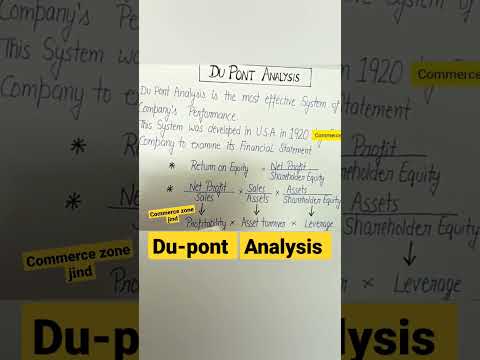
DuPont Analysis is a powerful tool for accountants to dissect the components of Return on Equity (ROE), providing a deeper understanding of a company’s financial performance. By breaking down ROE into its constituent parts, accountants can pinpoint the specific areas where a company excels or needs improvement. This decomposition helps in making more informed financial decisions and strategic planning. The 3-step DuPont analysis model states that if the net profit margin, asset turnover, and financial leverage of a company are multiplied, the output is the company’s return on equity (ROE). It also helps identify which efficiency (operational, asset use, etc.) is higher for a firm. Asset turnover, another element of DuPont Analysis, measures how effectively a company utilizes its assets to generate sales.
What is the DuPont Formula?
Walmart Inc. provided its Consolidated Statement of Income and Balance Sheet for the tax year ending January 31, 2023 in its 2023 Annual Report. Using the information from these two financial statements, we can calculate the 3-step and 5-step variations of the DuPont analysis. The DuPont analysis model was developed by Donaldson Brown, an electrical engineer who worked at DuPont Corporation in the early 1900s. When DuPont Corporation bought substantial stock in General Motors a few years later, Brown used DuPont analysis to determine shareholder return and suggest improvements to its financial situation.
DuPont analysis is a useful tool for evaluating the components that make up a company’s ROE calculation. Just keep in mind the limitations of this formula as it relates to the quality of the inputs. Let’s say an investor has been watching two similar companies, SuperCo and Gear Inc. Most companies should use debt with equity to fund operations and growth. Not using any leverage could put the company at a disadvantage compared with its peers. However, using dupont equation too much debt in order to increase the financial leverage ratio—and therefore increase ROE—can create disproportionate risks.
ROE is vulnerable to measures that increase its value while also making the stock riskier. Some sectors, such as the financial sector, rely on high leverage to generate acceptable ROE. Other industries would see high levels of leverage as unacceptably risky. DuPont analysis enables third parties that rely primarily on their financial statements to compare leverage among similar companies. The DuPont analysis is a formula used to evaluate a company’s financial performance based on its return on equity (ROE).
Klicken Sie auf den unteren Button, um den Inhalt von YouTube nachzuladen.
Inhalt laden
Leave A Comment